Queer Places:
Eton College, Windsor SL4 6DW, United Kingdom
University of Cambridge, 4 Mill Ln, Cambridge CB2 1RZ
St John the Baptist Churchyard, Hall Dr, Hagley, Stourbridge DY9 9LG, United Kingdom
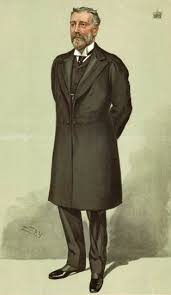 Charles George Lyttelton, 5th Baron Lyttelton and 8th Viscount Cobham (October 27, 1842 – June 9, 1922), was a prominent Victorian aristocrat, politician, first-class
sportsman, and public servant whose life bridged elite academia, estate governance, and national administration.
Charles George Lyttelton, 5th Baron Lyttelton and 8th Viscount Cobham (October 27, 1842 – June 9, 1922), was a prominent Victorian aristocrat, politician, first-class
sportsman, and public servant whose life bridged elite academia, estate governance, and national administration.
Born on October 27, 1842, at Hagley in Worcestershire, he was the eldest son of George William Lyttelton, 4th Baron Lyttelton (1817–1876), and his first wife, Mary, née
Glynne (1813–1857). He grew up amidst a large and distinguished family, sharing his youth with numerous siblings: Meriel, Lucy, Albert, Neville, George, Lavinia, Mary,
Arthur, Robert, Edward, and Alfred, alongside his later-born sister Sarah.
Following in a distinguished family tradition, young Charles was educated at Eton College, where he distinguished himself as a scholar. He then entered Trinity College,
Cambridge, on October 1, 1859. Possessing a formidable intellect, he engaged with both the Mathematical and Classical Triposes before achieving a First Class in the Law
Tripos, graduating with his BA in 1864 and later receiving his MA in 1867. Like his younger brother Alfred, Charles was a member of the elite intellectual society, the
Cambridge Apostles. Decades later, his deep ties to his former school were cemented when he served as a Fellow of Eton from
1891 to 1918.
Beyond his academic pursuits, Lyttelton was an exceptional athlete. He earned his cricket "blue" playing for Cambridge University from 1861 to 1864 and later maintained a
central role in the sport's administration as President of the Marylebone Cricket Club (M.C.C.) in 1886. Beyond the pitch, he earned renown as one of the finest "shots" in
England, celebrated as a key member of the elite Holkham shooting team.
Entering public life, Lyttelton served as the Liberal Member of Parliament for East Worcestershire from 1868 to 1874. In 1878, he married the Hon. Mary Susan Caroline
Cavendish (1853–1937), daughter of William George Cavendish, 2nd Baron Chesham. The couple had four children: John Cavendish Lyttelton (1881–1949), Frances Henrietta
Lyttelton Guest (1885–1918), Rev. Charles Frederick Lyttelton (1887–1931), and Richard Glynne Lyttelton (1893–1977).
Upon the death of his father on April 19, 1876, he succeeded to the peerage as the 5th Baron Lyttelton. His responsibilities expanded further in 1889 when he inherited
the title of 8th Viscount Cobham from his distant kinsman, the last Duke of Buckingham.
Lyttelton balanced his legislative duties with extensive administrative service for the Crown. He acted as a Land Commissioner from 1881 to 1889 and a Railway
Commissioner from 1891 to 1905. His expertise in economic and domestic affairs led to his appointment to the Royal Commission on Agriculture in 1893, where he subsequently
served as Chairman in 1896, followed by a tenure on the Royal Commission on London Traffic from 1903 to 1905. He also contributed to the cultural sphere as a Trustee of the
National Portrait Gallery.
Charles George Lyttelton passed away on June 9, 1922, at the age of 79, and was laid to rest at St John the Baptist Churchyard in Hagley, Worcestershire. His legacy
remains deeply woven into the fabric of late 19th- and early 20th-century British public life, defined by traditional aristocracy, public stewardship, and a rich family
lineage.
References:
Other references:
- A Cambridge Alumni Database (Venn): University of Cambridge record for Lyttelton, the Hon. Charles George (LTLN859CG), detailing his admission to Trinity College, academic degrees (Mathematical and Classical Triposes, 1st Class Law Tripos, BA 1864, MA 1867), and sporting achievements.
- Who's Who (Vol. 59, 1907): Entry for COBHAM, 8th Viscount (cr. 1718), Charles George Lyttelton, detailing his public offices, commissions, and peerage history.
- Debrett’s Peerage and Baronetage: Standard genealogical records for the Lyttelton family lineage, barony, and viscountcy.
- The Book of Blues: Historical records of Oxford and Cambridge athletic blues and sports participants.
- G.E.C. (George Edward Cokayne): The Complete Peerage, providing authoritative documentation on the 5th Baron Lyttelton and 8th Viscount Cobham titles.
- Arthur Charles Fox-Davies: Armorial Families, detailing the heraldry and lineage of the Lyttelton family.
- Scott, MSS.: Historical manuscript collections detailing family and estate records.
- The Times: Obituary and biographical notices published on June 12, 1922, following his death on June 9, 1922.
- Vanity Fair (May 1904): Caricature and accompanying biographical profile of Viscount Cobham ("Cricket, Railways & Agriculture") by Leslie Ward ("Spy").
Support this project
This website is a passion project researched, developed, and funded entirely by me. If you find the content valuable and would like to help support the ongoing research and hosting costs, any contribution is deeply appreciated.
Thank you for keeping this independent resource alive!
My books on Amazon: Elisa Rolle's books
BACK TO HOME PAGE
